Seasons
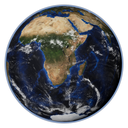
Fly Earth around the Sun, then stand anywhere on it. Seasons come from the tilt, not from how close we are to the Sun.
- Noon Sun
- 73°
- Rises in the northeast, sets in the northwest
- Daylight
- 14 h 51 m
- 14.8 hours
- Noon sunlight
- 96%
- as strong as a Sun straight overheadof an overhead Sun
June 21. 40°N: Summer. Noon Sun 73 degrees, 14 h 51 m of daylight, 152.0 million kilometers from the Sun.
Drag Earth all the way around the Sun and watch the white axis. It never turns: it always points toward the North Star. That is why the north leans toward the Sun for half the year and away from it for the other half.
What students walk away with
- 1Earth's axis is tilted and always points the same way in space, so each hemisphere leans toward the Sun for half the year.
- 2Leaning toward the Sun means a higher Sun, longer days, and more concentrated sunlight: summer.
- 3Distance is not the cause. Earth is closest to the Sun in January, during the northern winter.
Standards
- MS-ESS1-1 Patterns of the Earth, Sun, and Moon
- HS-ESS1-4 Orbital motion
Grades 6 to 12. Question sets for middle school, high school, and upper high school.
How the model works
Earth follows its real orbit, an ellipse so close to a circle (eccentricity 0.0167) that the difference cannot be seen, with the Sun at one focus. The distance readout comes from that ellipse. Earth is drawn about 4,000 times too big (more on a phone) and the Sun about 30 times too big, so both can be seen.
The Sun's height and the day length come from Earth's place on the orbit and the tilt, so the tilt slider changes them; at 23.4° the Sun's position matches the Astronomical Almanac within a few hundredths of a degree. Day length is for the Sun's center with no bending of light by the air, so real sunrise to sunset runs a few minutes longer. Noon sunlight is how concentrated the beam is on flat ground, before the air absorbs any of it.
Seasons are named by month the way weather services count them (in the north, summer is June, July, and August). The pin marks a latitude, not a time of day; the globe's slow turn only shows it is a globe.
Run it with a class
Pick the questions, get a class code, and watch answers arrive live. Students need only a first name.
Set up an assignment